
How China solves the renewable intermittency issue

Earlier this month, Germany and UK made news by having a prolonged period of Dunkelflaute. This is a phenomenon in winter times where Northern countries get very little from their renewable powers due to a low wind period. This situation is particular acute for countries like UK and Germany since they have minimum nuclear power and get very little sun during those times. A lot of the pro-nuclear and anti-renewable crowds then reacted with glee on how “stupid” the Germans were to rely on the unreliable solar and wind.
As anyone who read my tweets can attest, I’m both pro-nuclear and pro-renewables. Recently, I wrote about the success of the city of Haiyang in becoming a 0-carbon city by massively utilization steams from nearby Nuclear plants to provide heat for residential and industrial usage. Also does desallination.
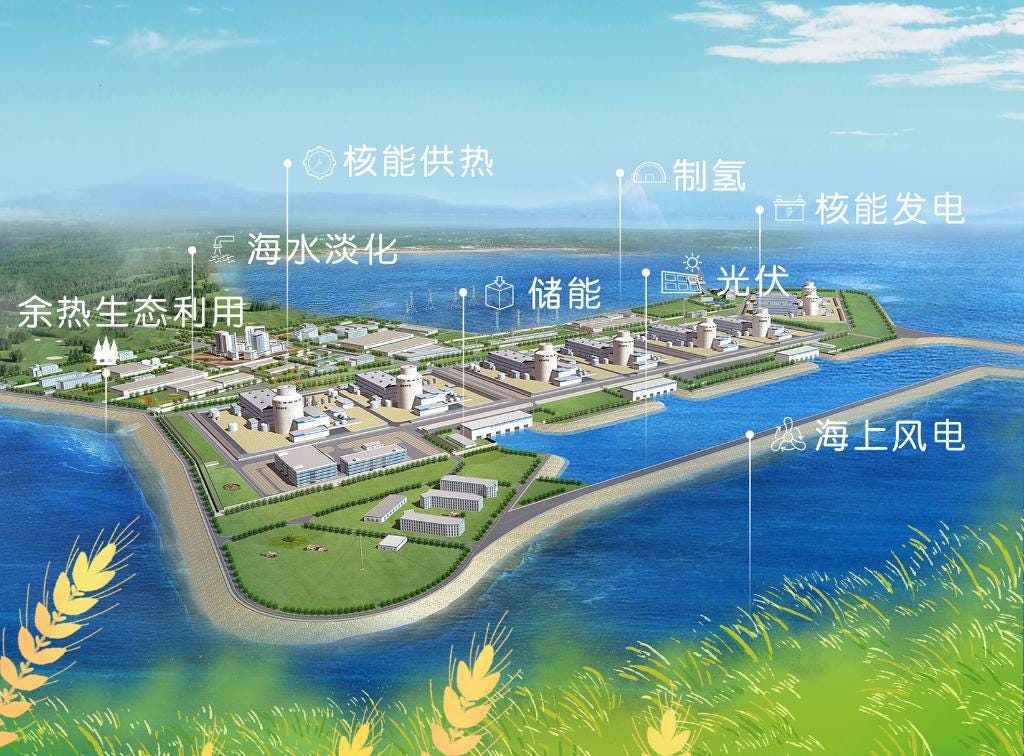
Note that even in their outline, nuclear does not take the full load of energy demand for Haiyang. They augment it with plenty of offshore wind, solar panels, battery ESS and hydrogen production in their grid. All of this has led to significantly improved air quality as documented in this People’s Daily article.
Even as I note the importance of nuclear power to the long term energy transition and grid in China, it is also quite obvious that nuclear power has a lot of limitation. China is probably the best at building new nuclear plant, but it still takes 5 years for it to build the latest Guohe-1/CAP-1400 plant in Shidaowan. That type of progress is not fast enough to meet China’s continued demand for more energy. China is not a developed country. It’s energy continues to grow at med to high single digit every year. To put things into perspective, this is the power generation pattern of various energy sources in China up until October.
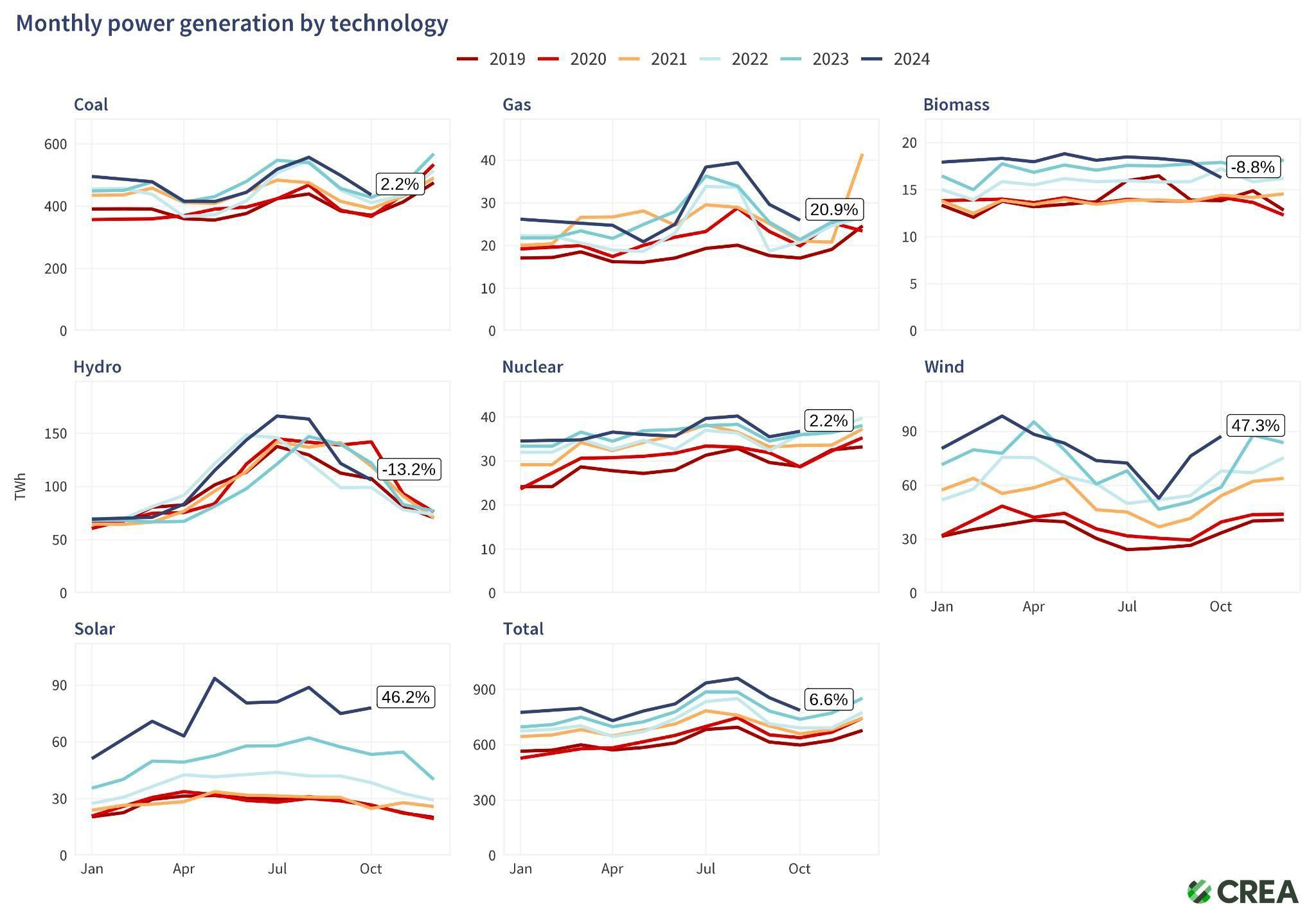
You will see here that Solar power generation is up 46% YoY in Oct and Wind is up 47%. Nuclear is only up 2% during this time. You simply cannot compare the growth of renewable energy vs nuclear. The former can be built and connected to the grid at much faster speed and lower cost.
However, how can China address the intermittency problem that the Brits and Germans experienced? First of all, China is a much larger country where different regions have different solar and win power patterns throughout the year. As such, it will never encounter the same level of depressed renewable energy generation as those Northern European countries. Even so, it is quite clear that hydro and solar are going to be generating significantly less power in winter than summer time. All the charts show that. The answer to that is obviously Battery Energy Storage System (BESS) and smart grid.
First, let’s just talk about the massive cost advantage of renewable power generation. Now, I have always thought that most of the cost of renewable power comes in the form of up-front capex + transportation and storage. It is intuitive that solar and wind do not require buying and transporting fossil fuel to your power plant. As such, the only cost involved here are the people keeping watch on the equipments and doing regular maintenance. Even on this front, Goldwind said it has moved to L3 technology on its wind turbine.
Engineers no longer need to go on-site & live close to there. They can inspect from far away. Reducing inspection hrs by 70% & fault repair time by 10% vs L2. Aside from reduced operational cost, this also makes wind farm more scalable. The wind farms are often located in remote areas. If every farm needs many engineers nearby to operate, then how can you have mass deployment of wind farms? With greater automation, wind farm operation cost continue to drop & also makes inspection job more appealing to highly qualified technicians. As such, solar and wind production cost will continue to drift toward free. As capex continue to drop and interest rate remains low, it is really hard to beat its economics.
Recently, I listened to a clip where someone in China just described how China plans to address the intermittency problem. First, he said the following regarding to the cost of production for different energy sources.
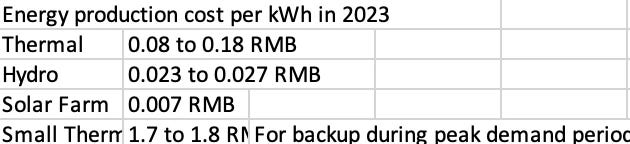
As you can see, Solar here is basically $1 per MWh of production. Thermal is at least 11 times more expensive at $11 per MWh. Hydro is at around $3.5 per MWh. Hydro kind of has the same profile as wind and solar. It has very high capex, but low cost of operation after that. Of course, Hydro does have significantly greater environmental cost and human cost (in its construction) than both wind and solar. It also costs more to operate and maintain. It does have the advantage for being able to operate for basically as long as you maintain it.
You can also see the bottom line there of small thermal plant. That is basically backup thermal plant that China has in every city to deal with intermittency problem for wind and solar and peaking issues. As you can see, it is extremely expensive at $220 per MWh. This would make sense, since it is sitting idle for most of the year and only operates during the demand peaking and low renewable periods of peak winter and peak summer.
So, how well does energy storage address this? Well, let’s talk about what they had before. Pumped Hydro energy storage has been built across China. Unfortunately, it is limited by geography and has low energy retention. The video mentioned that just 40% of the generate electricity is retained by pumped hydro. So despite the fact that it is the cheapest to build, pumped hydro is not ideal.
That is why China has massively ramped up Battery ESS in the past two years. We know that battery prices have really crashed recently as China massively ramped up upstream supply chain and battery production capacity. BESS prices are basically perfectly aligned with battery prices. As we move toward cheaper LFP and Sodium Ion Battery prices, BESS price will continue to drop. BESS are much better at energy retention than Hydro, even across long period of time. Huawei’s smart grid ESS solution can retain up to 92% of stored energy. We have now seen BESS solutions for all kind of customers. There are the products for the large renewable farms to even out their supply of clean energy to the grid. These products are often also purchased by the grid operators themselves to even out the energy demand and supply situation across the day. We also have industrial and residential ESS for distributed solar power generation where period of power consumption rarely aligns with period of power generation. That’s what BESS best for. It is an energy store that can charge and discharge more quickly than any fossil fuel. See below for all the places that BYD envisions its BESS to be used in.
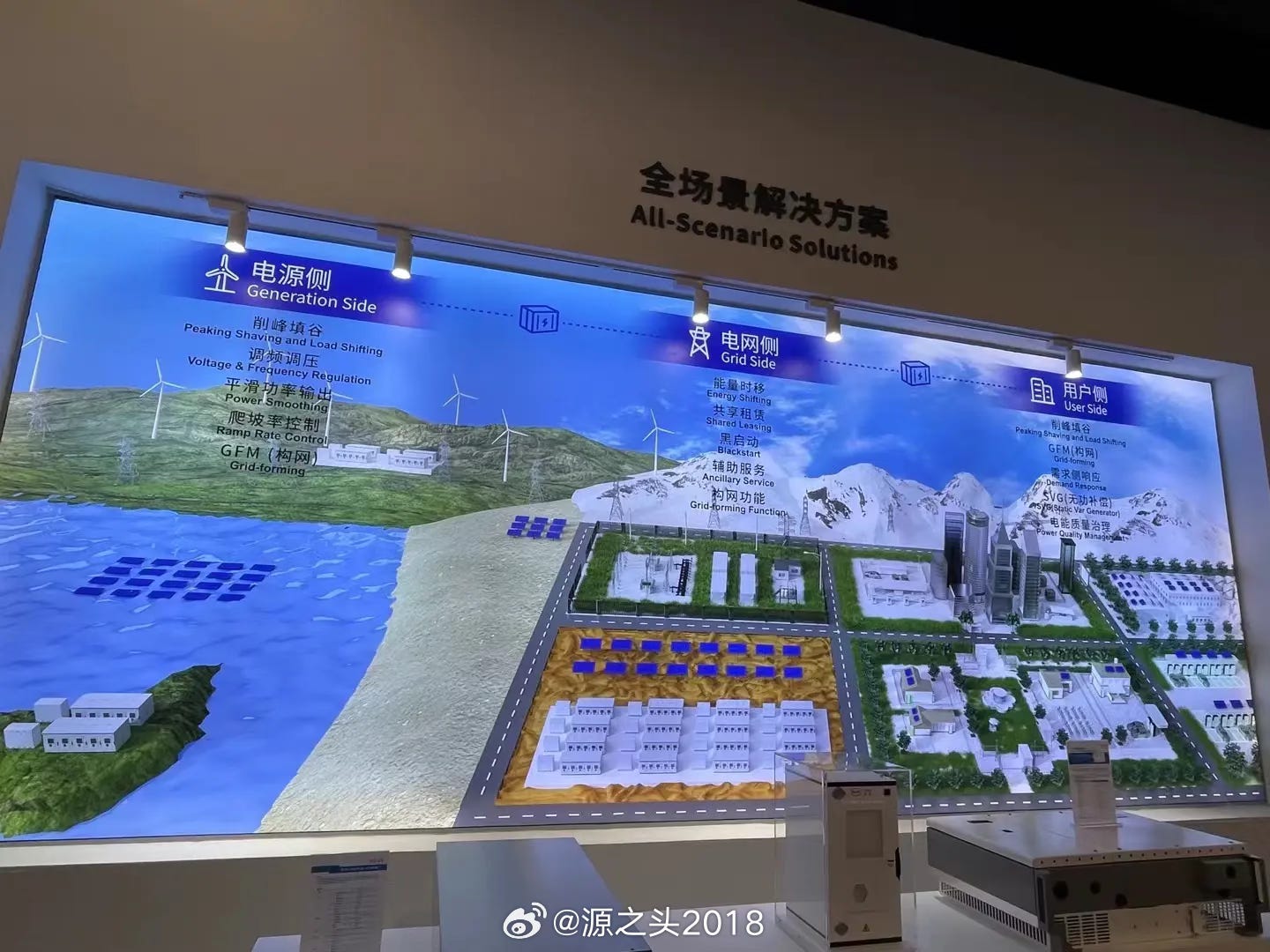
I think battery storage should be able to easily handle power generation and demand mismatch over the period of few weeks. For longer period and large mismatch, they probably will use pumped hydro power as well as ammonia or hydrogen. But at a bare minimum, this BESS should take many of the high cost backup thermal plants out of operation since large enough BESS can fully even out power mismatch in shorter period.
Beyond, we are also starting to read about EVs contribution to the grid through Vehicle-to-Grid (V2G) and how that’s helping to deal with power peaking issues in Shenzhen. According to this recent report, Shenzhen now has over 1 million NEV (72.6% penetration) and has built 670 super chargers (with goal of 1000 per year end). It also has a digital energy management system "Shenzhen Virtual Power plant" where V2G allows discharge during peak power consumption to help power grid during peak load. This one particular super charging station in 莲花山 can apparently discharge 2.16MW. It is rated to have maximum adjustable capacity of 2.76MW to the Shenzhen Virtual Power Plant. As such, this supercharging station can add even more discharge capacity.
If we consider that the peak power demand for a city like Shenzhen is over 10GW. If there are 40000 public chargers in a few years and half of them are used during peak demand period for V2G. 20000 chargers discharging at 10kW each would supply 2GW of power to the grid. That is the type of power sharing that EVs can contribute to the energy grid. This type of technology will take a few years to fully built up and working perfectly. However, one can see that Shenzhen is the pioneer here and that having a bunch of mobile BESS around can significantly address the issue of power mismatch. More than anything else, EVs are not only the solution to moving away from usage of oil in transportation, they are also part of the solution to moving energy grid to fully renewable. This seems like a national security type of project for China, so I do expect them to push very hard here and succeed.
how is the V2G supposed to get buy-in by car owners, I wonder? Or is it mostly for bus-fleets? Owning a BEV, I only connect it to my charging station at home, when my battery is low, usually in the evening every 1-2 weeks. I don't mind if it would discharge to support the grid, say until midnight, as long as it's fully charged by morning. But if I had to go to a paying charging station outside, I definitely would want it to charge as quickly as possible, and not end up discharging my car. Do you know how that works?
Unfortunately, BESS won't solve the energy demand problem in winter. Costly thermal energy will still be part of the energy mix in the foreseeable future. Hydrogen is a potential candidate for seasonal energy storage but the question remains whether the price can drop enough to compete with fossil energy